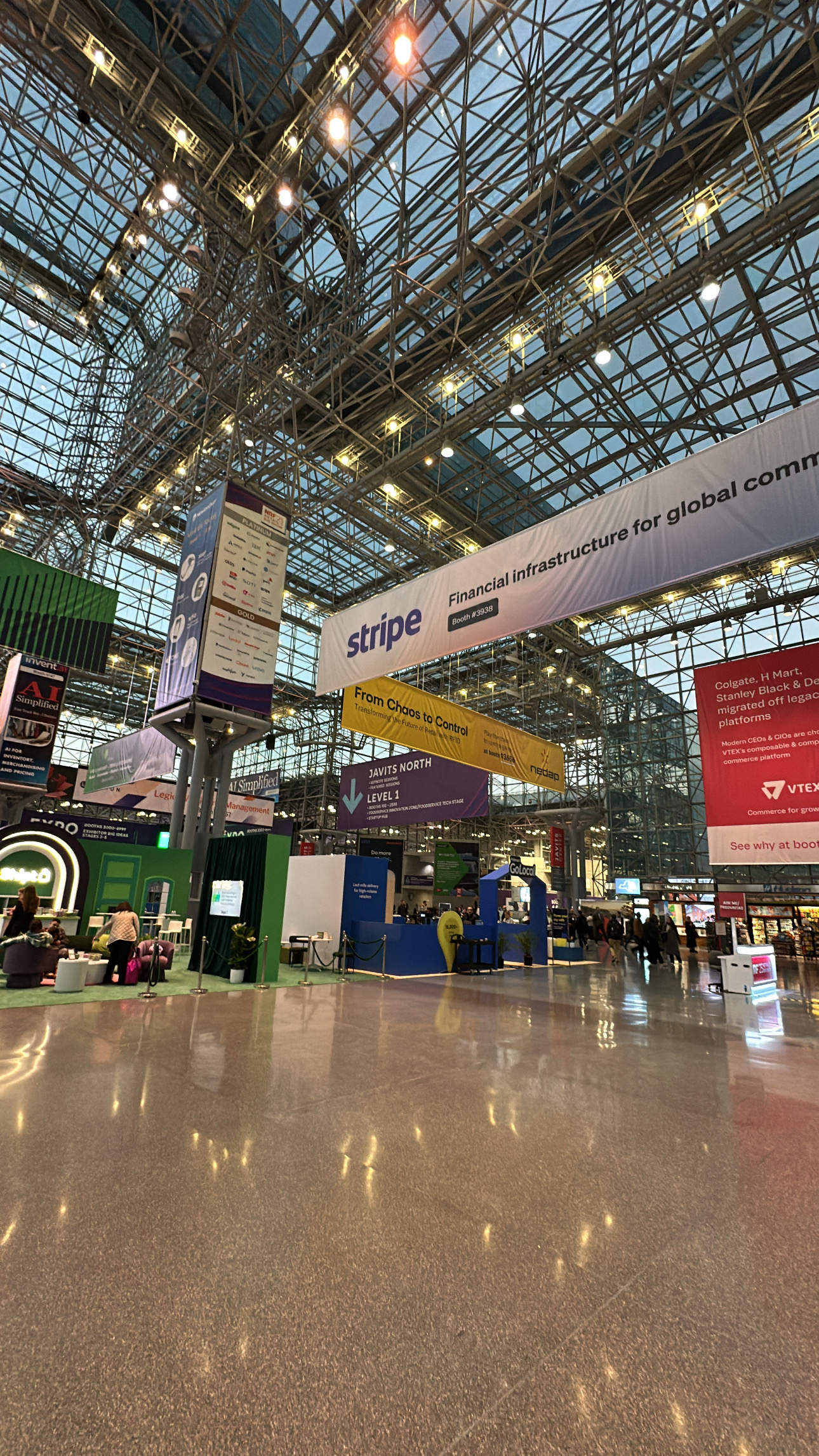
Over 40,000 retail professionals converged on New York City’s Javits Center for NRF 2026: Retail’s Big Show, January 11–13. After a turbulent year defined by tariff volatility, a shifting labor market, and the relentless acceleration of AI adoption, this year’s event carried a distinctly different energy. The conversations were sharper, the technology more tangible, and the strategic questions more urgent. Here are five takeaways that stood out.
1. AI Has Moved from Buzzword to Business Case
NRF introduced a dedicated AI Stage this year, and it was standing room only for most sessions. But the real signal was not the stage itself. It was the maturity of the conversations happening on the expo floor. Simbe unveiled Tally 4.0, an AI-enhanced shelf-scanning robot with edge computing that processes data on-device rather than in the cloud. When I spoke with vendors, the question had shifted from “will retailers adopt this?” to “how do we integrate this into existing workflows?”
Perhaps the most striking data point came from 7-Eleven, whose head of talent acquisition shared that conversational AI chatbots for applicant support saved corporate store leaders an estimated two million hours annually. That is not a pilot program. That is operational transformation at scale.
The headline partnership announcement, Walmart and Google’s Gemini Universal Commerce Protocol, confirmed what many of us have been tracking: agentic AI is moving from discovery to transaction, and the retailers who build the infrastructure now will own the next decade of consumer engagement.
2. The K-Shaped Economy Is Reshaping Strategy
Oxford Economics chief U.S. economist Michael Pearce opened with a 2.8% GDP growth forecast for 2026, a meaningful improvement over last year’s 2.2%. But the optimism came with a caveat that every retail strategist should internalize: the K-shaped recovery continues to bifurcate the consumer base. Higher-income households are recovering strongly. Lower-income shoppers remain under pressure.
NRF chief economist Mark Mathews noted that consumer sentiment is at a record low despite improving hard data on income and sales. Pearce positioned this as part of a global shift toward “perceived pessimism,” influenced by changes in how data is captured and filtered through political affiliation. The implication for retailers: build your strategy on transaction data and basket analysis, not on sentiment surveys. The consumer is spending. They just do not feel good about it.
3. Unified Commerce Has Replaced Omnichannel
The language has shifted. “Omnichannel” was barely mentioned on the main stages. Instead, speakers consistently used “unified commerce,” a recognition that the channel-centric framework has given way to something more integrated and customer-centric.
Instacart’s VP of commercial partnerships and Giant Eagle’s senior leadership discussed how loyalty programs are becoming the connective tissue across channels, not as a promotional crutch, but as an “engine for experience.” Giant Eagle shared a candid lesson from their Scan-and-Go rollout: shoppers did not want to live inside a single app while navigating a store. That insight led them to pivot toward an item-location feature that became one of their highest-usage tools. The takeaway is clear: listen to the friction, not the feature request.
4. Health-Forward Is the New Growth Lever
If there was a sleeper theme at NRF 2026, it was health. PepsiCo U.S. beverage president Michael Del Pozzo discussed how consumer demand for “lifestyle support” is reshaping the company’s entire portfolio, citing the Gatorade reformulation (now low-sugar and free of artificial colorants) as evidence of a structural shift. “The functional nature of snacking and beverages is not going anywhere,” he said.
Giant Food’s head of loyalty described how the grocer is investing in in-store health resources and nutritious food assortment to capture cross-shoppers at a time when loyalty is wavering. For retailers still thinking of “better-for-you” as a niche category, this should be a wake-up call. Health is becoming the value proposition, not an add-on.
5. Evolution, Not Transformation
Taco Bell’s chief digital and technology officer Dane Mathews offered what may have been the most grounded perspective of the entire show. Rather than framing the company’s digital journey as a “transformation,” he described it as an evolution, building on what already works rather than attempting to overhaul the brand. “For Taco Bell, it’s really more of an evolution… not a seven-year journey of transformation,” he said.
This framing resonated because it reflects a broader maturation in the industry. The retailers who are winning are not the ones making the loudest announcements about digital transformation. They are the ones quietly integrating technology into existing workflows, empowering their teams, and staying relentlessly focused on the customer experience. Shopify president Harley Finkelstein reinforced this point alongside Good American’s Emma Grede and Gymshark’s Ben Francis, emphasizing that speed to market comes from building smarter ecosystems, not from starting over.
Looking Ahead
NRF 2026 drew record-breaking attendance and announced a global expansion to Riyadh in 2027. The show floor was denser, the sessions more tactical, and the executive conversations more candid than in recent years. What struck me most was the absence of hype. The industry is no longer asking whether AI will change retail. It is asking how fast, and who will be left behind.
For enterprise strategists, the mandate is clear: invest in unified commerce infrastructure, build AI capabilities that solve real operational problems, and recognize that the K-shaped consumer demands a portfolio strategy, not a one-size-fits-all approach. The next chapter of retail will be written by leaders who can hold complexity without losing clarity.